We remain fully operational. Our teams are working around the clock to ensure your deliveries continue safely.

DOWNLOAD THE APP


Copyright © 2025 Desertcart Holdings Limited
DOWNLOAD THE APP

Buy anything from 5,000+ international stores. One checkout price. No surprise fees. Join 2M+ shoppers on Desertcart.
Desertcart purchases this item on your behalf and handles shipping, customs, and support to Isle of Man.
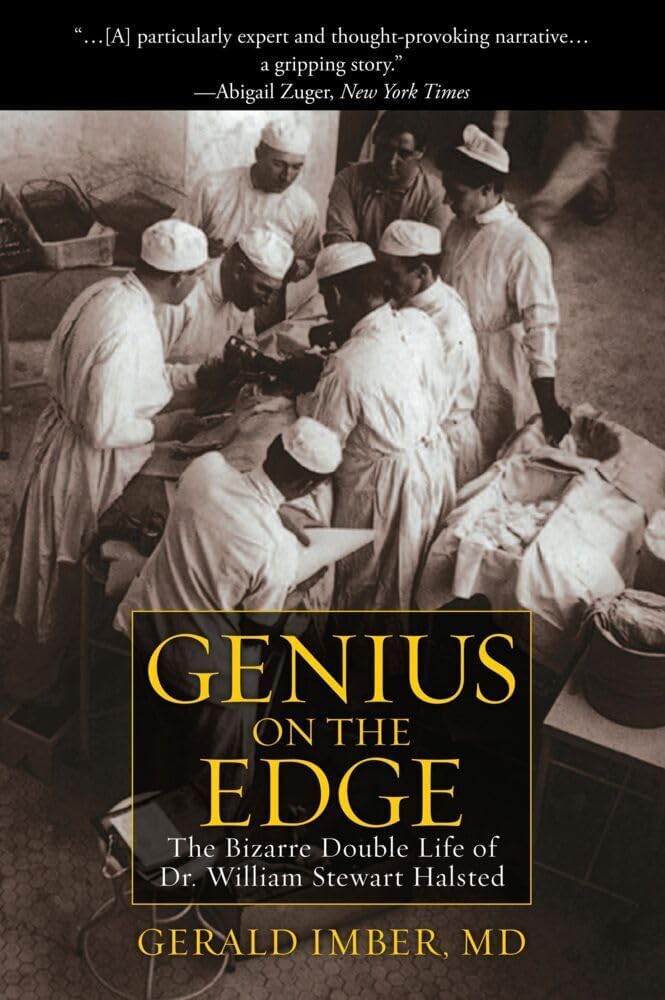
Genius on the Edge: The Bizarre Double Life of Dr. William Stewart Halsted: 9781607148586: Medicine & Health Science Books @ desertcart.com Review: Fascinating book about a fascinating man and his times - This is a fascinating exploration of one of American Medicine's great men. It tells the story of Halsted, but also gets into the other great men of those key times and places that were so formative to medical treatment and training in America. This book is thorough enough to cover the subject, but not so deep that it gets tedious. It presents information about what may be some of the controversial aspects of some of those men without passing judgement or making assumptions that cannot be supported. Overall it is a great presentation of a great man who lived in a great age of American Medicine, and I can't recommend it highly enough. Review: Excellent book on a great American surgeon - Well written biography of a famous surgeon who changed completely how surgery was performed with the use of antiseptic procedures and innovative operative techniques as well as establishing the still accepted approach of training surgeons. All these achievements were accomplished despite cocaine addiction. This book also explores the rise of John Hopkins Hospital and its medical school. A really fascinating read for anyone interested in the rise to prominence of American medicine before and after 1900.
| ASIN | 1607148587 |
| Customer Reviews | 4.6 4.6 out of 5 stars (254) |
| Dimensions | 6 x 1.1 x 9 inches |
| Edition | 1st |
| ISBN-10 | 9781607148586 |
| ISBN-13 | 978-1607148586 |
| Item Weight | 1.3 pounds |
| Language | English |
| Print length | 400 pages |
| Publication date | February 1, 2011 |
| Publisher | Kaplan Test Prep |
N**N
Fascinating book about a fascinating man and his times
This is a fascinating exploration of one of American Medicine's great men. It tells the story of Halsted, but also gets into the other great men of those key times and places that were so formative to medical treatment and training in America. This book is thorough enough to cover the subject, but not so deep that it gets tedious. It presents information about what may be some of the controversial aspects of some of those men without passing judgement or making assumptions that cannot be supported. Overall it is a great presentation of a great man who lived in a great age of American Medicine, and I can't recommend it highly enough.
J**N
Excellent book on a great American surgeon
Well written biography of a famous surgeon who changed completely how surgery was performed with the use of antiseptic procedures and innovative operative techniques as well as establishing the still accepted approach of training surgeons. All these achievements were accomplished despite cocaine addiction. This book also explores the rise of John Hopkins Hospital and its medical school. A really fascinating read for anyone interested in the rise to prominence of American medicine before and after 1900.
J**Y
Worthy Intro to the Father of Modern Surgery
Other than running across his name here and there, and some very brief sketches in works about his contemporaries, I had little knowledge of William Halsted coming in to this fine, but flawed biography. Virtually all of us need to say a silent "thank you" to Halsted. Without the innovations he painstakingly thought and practiced through, implemented, and trained others to follow, a lot of us, and a lot of our loved-ones, wouldn't be alive right now. Halsted and his colleagues at the then-newly-created Johns Hopkins genuinely, and for the most part literally, brought medicine into the 20th Century. The advancement of medicine between, say 1890 and 1920 is breathtaking. And Halsted was at the forefront, alongside Ostler and preceding Cushing. (Both, by the way, subjects of wonderful biographies by Michael Bliss, both highly recommended and both readily available: William Osler: A Life in Medicine ; Harvey Cushing: A Life in Surgery .) Halsted provides a challenge to the biographer: He was reticent and secretive. He shunned publicity. His largest body of personal correspondence was addressed to his wife, who's sister destroyed all of his letters after his wife's death. His colleagues mostly honored his privacy and, in most cases, didn't know much about the private man themselves. What Imber has done is really kind of amazing considering the lack of primary material: He has presented us with a surprisingly full portrait, all things considered. To fill in some of the unavoidable void, he creates a deep-focused backdrop Halsted's contemporaries and times. While it would be nice to have a clearer picture of exactly how Halsted's addictions affected his personal and professional lives, not even most of his colleagues were unaware of the addiction and/or the extent of his usage. Imber presents what is known, but wisely avoids either speculation or damnation. Some enigmas will just have to stay enigmas. The only real weakness here, as far as I'm concerned, is Imber's decision to organize the books by topic. This is not necessarily a problem, but in this case it results in a good-deal of time-jumping, backward and forward and I would periodically find myself confused when beginning a new chapter and suddenly finding myself several years in the past. While I was generally able to get my bearings pretty quickly, there were a number of times when I was confused for several pages before realizing, "oh, it's 1902 again," or some such. Imber covers a lot of ground here, in terms of medical and social history and the persons involved and so I can appreciate the decision, but a few marking posts here and there would have helped. Unlike a couple of other reviewers, I did not find the medical terminology bothersome and Imber does a good job of giving a quick thumbnail for most of the terms and procedures his audience are likely to stumble over. He also provides modern terminology for conditions and procedures now known by different terms. That was handy. In all, a very good read. I learned a great deal - both about Halsted himself, and his place in the fascinating world of medical history. And as someone who has gone under the knife on a few occasions: Thank you, Doctor Halsted. I'm glad to be alive.
N**5
A Surgeon Great Despite His Humanity
By way of full disclosure, I am also a plastic surgeon like the author, and know him. This book was recommended to me by a general surgeon friend, who believed that it was Halsted's cocaine and morphine addictions, which began at age 32 while he was experimenting with cocaine as a local anesthesic, that fueled his creativity. My opinion is that the truth is more complicated and more interesting. Halsted was great despite his addictions, but they clearly influenced his personality, his relationship with patients, with his peers, and his character as a teacher. Nevertheless, what he and his colleagues created at Johns Hopkins Hospital formed a pattern that the rest of us training in surgery a century later still follow, and from which we benefited immeasurably. This book is well-written and obviously the product of enormous research. It will interest not only physicians and surgeons, who should never forget their past, but non-medical readers who may not know the fascinating story of the seemingly primitive advances, so obvious to us – – like disinfecting wounds and wearing gloves during surgery – – that created Medicine as we know it today.
R**I
The Life of a Great American Surgeon, the Father of Modern Surgery
This biography of Dr. William Halstead, one of the founding fathers of modern surgery, is impressive. Although the title has a focus on his addiction to cocaine, brought about by his self-experiments on its use on surgery as a local anesthetic (a good marketing gimmick), the book is exceedingly complete on his life and works, based in part on a lot of published and original material. What I found most fascinating was to see about the birth of modern medicine at the Johns Hopkins Medical School, since I have been a medical educator for the past 40 years, and the fabulous contributions of Halstead, such as evidence-based surgery (based on meticulous and exhaustive experiments with animals), anesthesia, gentle surgical handling, hemostasis, asepsis, etc. all not invented by him, but applied as a whole set of procedures which revolutionized surgery at his time. Most of the US surgeons are indirect "children" of his school. I strongly recommend this fascinating biography for anyone interested in the history of medicine and in medical education.
G**T
THE BOOK PROVIDES A GREAT BACKGROUND ON THE DEVELOPMENT OF MEDICINE AT JOHNS HOPKINS AND GOES WELL BEYOND THE ROLE OF HALSTED. IMPORTANTLY IT IS A GOOD LESSON FROM THE PAST AS TO THE ULTRA CONSERVATIVE NATURE OF MEDICINE AND THE RELUCTANCE TO OF THE MEDICAL COMMUNITY TO ACCEPT OR ADAPT CHANGES IN THE WAY THEY PRACTICE. THE LESSONS OF THE HALSTED/OSLER PERIOD ARE JUST AS APT TODAY IN THE RELUCTANCE TO EMBRACE EVIDENCE BASED MEDICINE.
D**L
Known as father of American Surgery had a secret life of drug abuse and addiction. Still his output was far more than any surgeon at that time.An excellent biography extremely well written sometimes unbelievable.We as under graduate medical students heard about the now modified Halsted Mastectomy for cancer breast. A gem in every surgeons library.
O**A
著者のGerald Imber氏は形成外科医だそうです。アメリカにおける外科の父ともいえるWilliam Halstedの伝記であるとともに19世紀中頃から20世紀初頭の外科の発展や医学教育についても理解できる本です。Halstedの業績は、手術においては乳癌の根治的乳房切除術の創始、鼠径ヘルニア手術などで、特に前者は20世紀中旬までゴールドスタンダードでした。リスターの無菌手術を洗練させ、今では当たり前となった手術用ゴム手袋を開発しましたが、実は後に自分の妻となる手術場のナースの石炭酸や昇汞による皮膚炎の予防のためにグッドイヤーにゴム手袋を作らせたものでした。コカインを用いた局所麻酔も研究を行ったが、自分に実験投与する中でコカイン中毒となり、さらにその治療に使ったモルヒネの中毒にもなってしまった(Double Lifeの意味)。しかし鼠径ヘルニアの局所麻酔を最初に行ったのはクッシングだそうです。ほかに医学教育では外科レジデント制の採用で多くの優れた弟子を育て、その中には近代脳神経外科の父クッシング、泌尿器科のヤング、脳外科のダンディなどがいます。コカインやモルヒネ中毒で大学の教授として研究や治療を行ったことは現代人には理解しがたいことですが、当時はアルコール中毒よりもモルヒネに対して寛大であったようです。また特異な創設の経緯を持つジョンスホプキンス大学とその後の医学教育についても書かれていて、現代につながるメディカルスクールの歴史がわかります。なおプロローグでHalstedが母親に行った胆石手術が歴史的な最初の手術であるというのは誤りで Gifted Hands: America's Most Significant Contributions to Surgery によればジョンボッブスが最初とされています。
L**)
This book is simply superb. It is brilliant. Every surgical trainee, irrespective of their specialty, should read this book. It'll educate you in a character that contributed significantly to the rich history of our craft (not job). It was recommend to me by a general surgical SpR in Oxford, towards the end of my NIHR ACF in vascular surgery, and in turn recommended to him by a colorectal consultant in Oxford (who has a strong interest in surgical history). The importance of this book cannot be over stated as it blasts out some errors other modern authors place in their books, e.g. Atul Gawande, as distinguished as he is states in the Checklist Manifesto that observation charts were a by-product almost of nurses attempting to log down information properly, to make their task easier. Of course this did occur, but the roots lie in William Halsted, and this is not made explicitly clear in AG's book. The detail in this book, from the opening couple of pages through to the evolution of perhaps one of the most inspiration figures in surgical history is impressively done, e.g. Halsted taught, and inspired, the legendary Cushing, Dandy Walker, Young, was taught by Bilroth (amongst others), and worked alongside Osler, Welch and other notables. It is a must read.
D**.
An excellent biography of the pioneering American surgeon WS Halsted. The author describes brilliantly the atmosphere during the planning and opening of the Johns Hopkins Hospital and School of Medicine in Baltimore, and illuminates the struggle to establish academic teaching units. I was surprised by his observation that the electrocardiogram had not been discovered by about 1918. Unfortunately such informative books are no longer in fashion among the new generation of medical historians.
Trustpilot
1 month ago
2 days ago